
For a few months, embeddings were everything. I got intrigued by some of those old "king/queen" videos and wanted to see if the gpt embeddings showed the same properties.
Endpoint: v1/embeddings
Models: text-embedding-ada-002, text-embedding-3-small, text-embedding-3-large
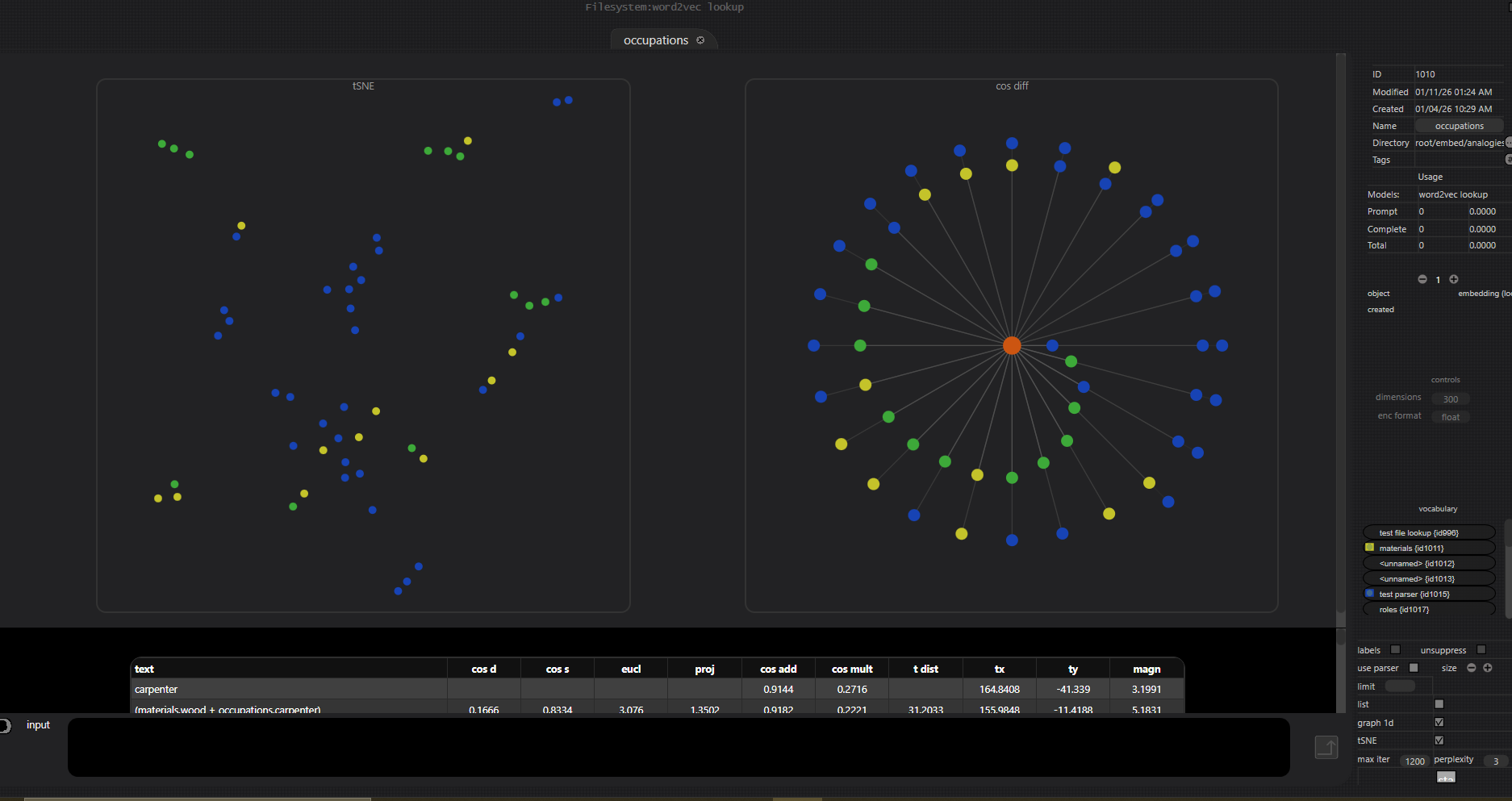
Those old gensim videos showed how vector arithmetic could produce something like a semantic transformation when working with word2vec embeddings. To reproduce with gpt embeddings, the software I've written has a fairly extensive set of vector operations: normalize, dot product, 7D curl (IYKYK), etc... Dimension reduction using tSNE. Mulling over adding umap.
Mostly, I am interested in operating on blocks of texts, but to test my setup I wanted to reproduce what I'd seen with the word2vec embeddings .
This software will read the text and binary files like those in the nlpl repository (http://vectors.nlpl.eu/repository). Currently, embeddings are read from the file on-demand and put into a database. The idea here is that relatively few embeddings will be of interest and once in the database, there is no need to spend time parsing the file.
Most of what I've done was with the GoogleNews-vectors-negative300.bin file and other word2vec output.
Nearest-neighbor searching is only among those embeddings in the database, unlike with gensim which provides a list of the top N closest matches in the entire vocabulary. Such a thing has no applicability when using the gpt embeddings with blocks of text but I still think it would be nice to have so I will probably implement some kind of FAISS/ANN scheme. I'll need to deal with a vector database at some point though.
I am releasing a version of the software that works with the nlpl files (http://vectors.nlpl.eu/repository), even though feature-wise it lags behind gensim for the target data. But if you want to play around with that data and don't want to deal with Python, you are welcome to use it.